

10/03/26
AI Slop and Manufactured Nostalgia: A Handworker’s Perspective on Glasgow’s Controversial AI Mural
AI is in the media again, and once again, it’s failing to replace or even represent hands. Helen Victoria Murray, Research Associate explores how the arts community of Glasgow have reacted to a recently-proposed public mural that was visibly AI-generated.
Glasgow, centre of the world-famous Glasgow Style design movement, pioneered by Charles Rennie Mackintosh, was already renowned for championing artists and independent creators. Since 2008, the built environment has been graced by a Glasgow mural series, on which local artists adorn the city’s iconic buildings and tenements. This City Centre Mural fund has been one of Glasgow City Council’s more successful initiatives, with the murals representing Glasgow’s storied history and vibrant present. It’s even enhanced city tourism, with visitors photographing the public art, and following the Mural Trail.
Yet some of this goodwill has been soured by a recent mural proposal to Glasgow City Council which is visibly AI-generated. The proposed mural, destined for 11 Elmbank Street, featured a rugged man clad in flat cap and dungarees, a steam engine, some windmills, and nondescript castle-shaped structures. Scottish fauna was represented by a stag, Highland cow and the most incongruous, a bald eagle (native to North America).
As Glasgow’s creative community flocked to social media to object, commentators were quick to notice the man’s hands appear to have fingernails on the pads of the fingertips. This AI-generated man was rendered to honour the handworkers who built Glasgow’s industrial heritage. But the effect is, unfortunately, the opposite. A worker’s hands, anatomically impossible, ineffectual, and unsettling when you look too close.
The proposer from Balmore Estates Ltd was quick to clarify that the AI-generated image was only concept art, intended to inspire a contracted artist. They claimed the image was not intended to take work from artists. But can handmade art ever authentically flow from such an artificial source?
The Glasgow mural controversy calls to mind the writings of Victorian Arts and Crafts designer, poet and Socialist campaigner William Morris, whose writing and ever-popular business Liberty & Co advocated for traditional craft practices and handmade items.
You must ask the question is it done by an artist or a machine – whether of flesh and blood or brass and steel […] if it is the latter have nothing to do with it: it will be worth [a] great [deal] less than nothing: if the former, well and good, only you must be very particular to see that it is done by an artist’s hand, executed that is to say thoughtfully and with pleasure: in that case, it will, I am sorry to say, be rare, and I imagine expensive, as things go now; only it will at all events be worth something.
- William Morris, ‘The Gothic Revival II’
Morris was speaking about Victorian machine-made ornament. Yet it is striking how shrewdly he prophesises the current challenges AI poses to artists and craftspeople. Images made by Artificial Intelligence are a threat to the arts not because they are better or more precise, but because they are instant and cheap at the point of use. In a culture of ever-increasing corporate targets and shoestring budgets, why pay a professional artist a living wage, when you can generate an image instantly? In his essay, ‘How I became a Socialist’, Morris outlines his personal definition of Socialism:
A condition of society in which there should be neither rich nor poor, neither master nor master’s man, neither idle nor overworked, neither brain-sick brain workers, nor heart-sick hand workers.
- William Morris, ‘How I became a Socialist’ (1894).
We see target-driven haste in the statement from commissioned muralist Rogue One (AKA Bobby McNamara), that the building owner had simply created the AI image to expedite planning permissions. Perhaps it was not idleness, but overwork that prompted this use of AI. There is a heart-sickness about the inauthentic vagueness of these Shortbread-tin visuals. The widely mocked bald eagle on the mural suggests that this AI model has been trained on nondescript Americana, pandering to generic nationalist feelings that have nothing to do with Scottish identity or Glaswegian history.
I’ve become fascinated by the image’s architecturally nonsensical castle spires. These structures seem to draw on a hybrid model of Stirling’s Wallace Monument and the University of Glasgow’s Gilbert Scott campus. Both these structures (completed in 1869 and 1891 respectively) are Victorian Gothic Revival – the style which Morris was speaking on in his call for work ‘done by an artist’s hand.’ Gothic Revivalism was highly referential, drawing on historic sources to construct Victorian urban landscapes. However, one aspect of Gothic Revival which was highly prized was its emphasis on the handmade, and on specialised craft. The referentiality of AI is a different matter – reducing the intricate, organic and hand-crafted forms of Gothic architecture into slop.
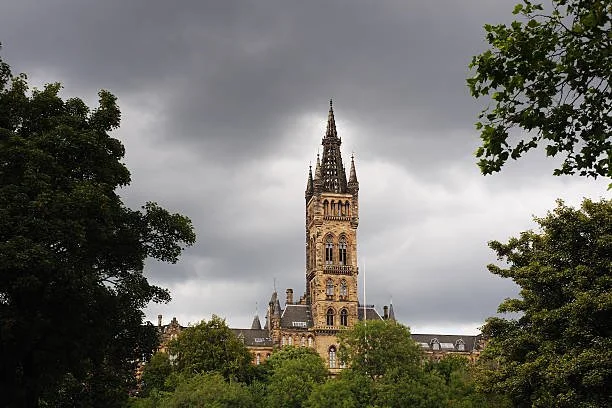
The University of Glasgow’s Gilbert Scott Campus.
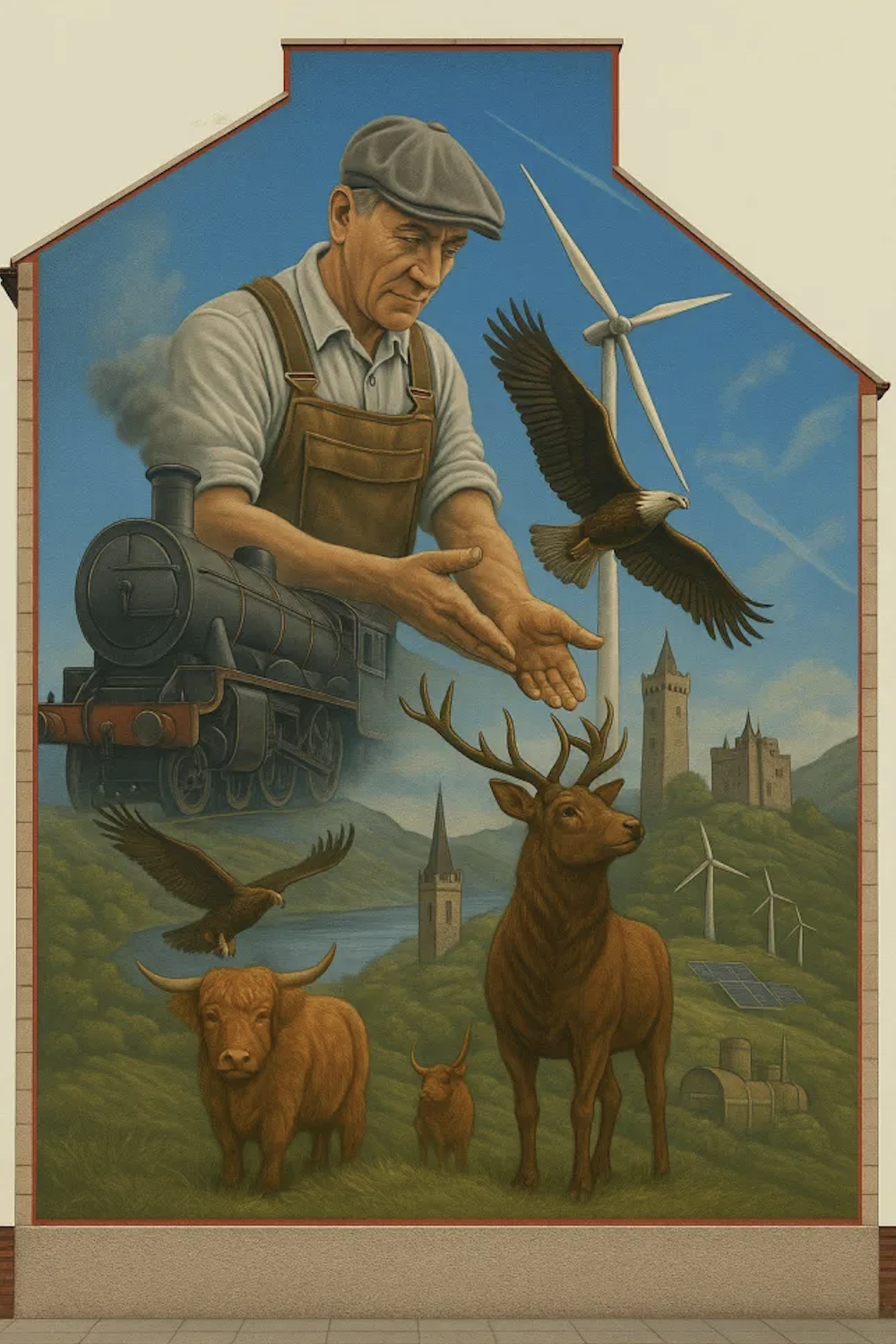
Image courtesy of Glasgow City Council via Metro UK.
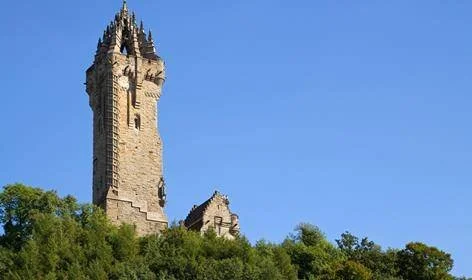
The Wallace Monument in Stirling
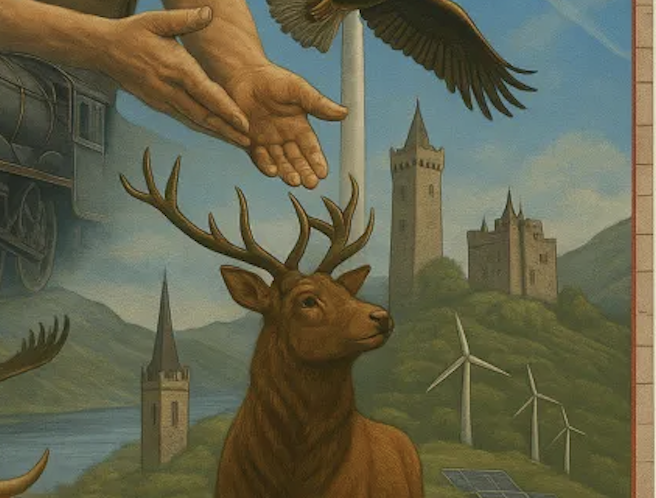
The AI-generated counterpart
William Morris did not necessarily enjoy being in Glasgow – in a letter of 1884, he describes the place as ‘coarse and raw’, and in 1889 as ‘woefully bad.’ Nevertheless, the city of Glasgow was a fixture in Morris’s lecture tours on Socialist subjects and Arts & Crafts principles. In his lecture, ‘Art and Labour’, delivered to the city of Glasgow in 1884, Morris prompted his audience to consider:
[The workman] must claim to live in a pleasant house and a pleasant place; a claim which I daresay many people would be inclined to allow for him – till they find out […] how impossible it would be to satisfy it under the profit-grinding system; until for example we consider what time, money, and trouble it would take to turn Glasgow into a pleasant place.
- William Morris, ‘Art and Labour’ (1884).
Morris’s desire to improve the city of Glasgow stemmed from his dislike of its utilitarian commercialism. Although the city is no longer encrusted with evidence of unchecked, coal- and steam-powered industrialisation, the environmental and human cost of AI is invisibly insidious. To propose – even conceptually – these uncanny slop hands as a city mural, perpetuates a new form of aesthetic disharmony in the city landscape under the same profit-driven motive.
Just as Morris’s Aesthetic values were intricately entwined with his Socialist politics, the rights of the workers are embodied in the works of their hands. The Victorian Hand project is currently in a phase of research exploring how the imagery and language of hands fuelled nineteenth-century labour reform. We are wondering how far symbolism of joined hands and hands at work were visible icons around which workers could frame their struggle for better social conditions. In the context of many emotive accounts of injuries to workers’ hands, AI’s failed attempt to capture a worker’s hands feels notably mawkish.
References
Annette Carruthers, ‘William Morris and Scotland’ The Journal of the Decorative Arts Society, 1850-Present 28 (2004), pp. 8-27.
Jonathan Geddes, ‘Controversial Glasgow Mural “Will Have Nothing to do with AI’, BBC News, 21 January 2026, Controversial Glasgow mural 'will have nothing to do with AI' - BBC News [Accessed 21/01/2026]
Glasgow City Centre Mural Trail, https://www.citycentremuraltrail.co.uk/ [Accessed 24 February 2026]
Josh Milton, ‘Massive AI-generated mural with American bald eagles approved by Glasgow council’, The Metro, 21 January 2026, Massive AI-generated mural with American bald eagles approved by Glasgow council | News UK | Metro News [Accessed 24 February 2026]
William Morris, ‘The Gothic Revival II’ in The Unpublished Lectures of William Morris (ed by Eugene D. Lemire) (Detroit: Wayne State University Press, 1969) pp. 74-93.
William Morris, ‘Art and Labour’, in The Unpublished Lectures of William Morris (ed by Eugene D. Lemire) (Detroit: Wayne State University Press, 1969), pp. 94-118.
William Morris, ‘How I became a Socialist’, Justice, 16 June, 1894 https://www.saskoer.ca/victorianproseandpoetry/chapter/how-i-became-a-socialist-by-william-morris/ [Accessed 09 March 2026]
Josh Pizzuto-Pomaco, ‘Rogue One announces he will paint Glasgow mural after AI row’, The Herald, 22 January 2026, https://www.heraldscotland.com/news/25788565.rogue-one-announces-will-paint-glasgow-mural-ai-row/ [Accessed 09 March 2026]
Laura Pollock, ‘Plan for AI-Generated Mural Gets Green Light from Council’ The National, 21 January 2026, Bid for massive AI-generated Glasgow mural given green light | The National [Accessed 21/01/2026]