
05/10/26
The Political Hand: Gesture and Power in Politics
Principle Investigators, Joanne Begiato and Mike Brown, reflect on the symbolic significance of hands in politics, past and present.
Have you ever noticed that when politicians want to appear sincere or authoritative, they often do a particular thing with their hands? Perhaps the most well-known of these are the ‘sand pinch’ gesture, popular among US Presidents since Bill Clinton, in which the tips of the thumb and forefinger are brought together, or the so-called ‘thist’ gesture, fist projecting outwards, thumb tucked over the knuckle of the forefinger, that has been deployed by successive British Prime Ministers since Tony Blair.
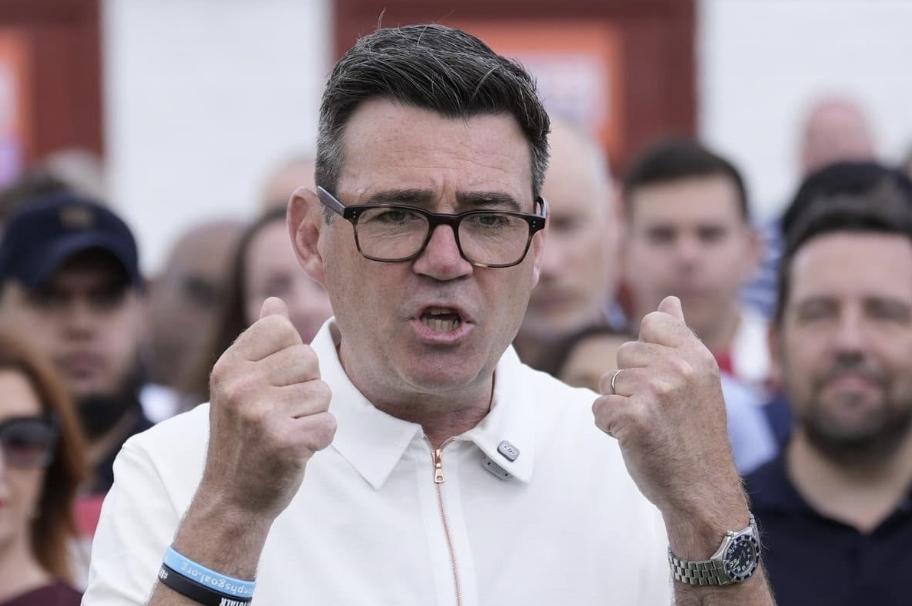
UK Prime Minister Andy Burnham making the 'thist' gesture after victory in the Makerfield by-election in June 2026.
Such gestures have a long history from the age of Cicero to that of Donald Trump and it’s an important one, because gestures are bodily acts that have a symbolic significance and which can be read for meaning. Importantly, an embodied gesture brings into being feelings for those who make that gesture as well as those who witness it, shaped by the circumstances in which it is encountered. Throughout history, the hand has formed the most expressive of all bodily political gestures. After all, while facial movements, such as eyes raised to heaven, might also convey feelings and express meaning, they were often hard to read at the visual distances that were customary in the pre-televisual era. Indeed, not only did hand gestures amplify the message of political speech, they might even be the only aspect of a speech that could be ‘read’ by audience members out of immediate earshot. So, what do hand gestures tell us when they’re used in the political arena?
The classical tradition established a system of ‘iconic’ standardized hand gestures, choreographed with oratory, which were understood to arouse emotions and feeling states on the political stage. By the Renaissance, there was even a manuscript tradition of drawing the emotions in gesture, from which both orators and actors took inspiration. The seventeenth century saw a rich published literature of hand gesture, culminating in John Bulwer’s Chirologia: or, The Naturall Language of the Hand, published together with its companion text, Chironomia or, the Art of Manuall Rhetoricke in 1644.
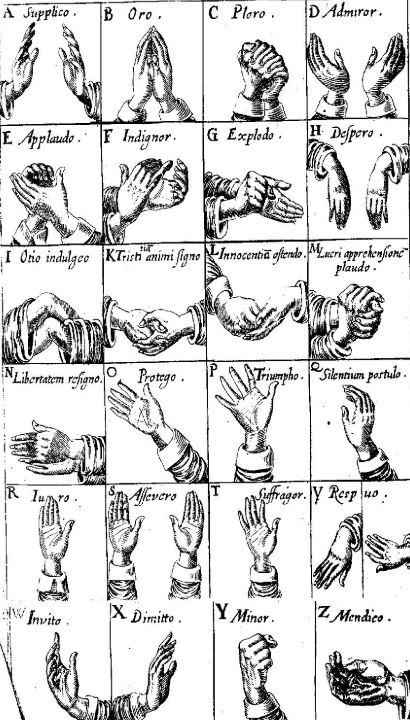
A 'Chirogram', taken from John Bulwer's Chirologia: or, The Naturall Language of the Hand (1644).
This found its way into political discourse and journalists’ and diarists’ descriptions of parliamentary debate reveal a repertoire of manual gestures, which were intended to stir emotions and affect the outcomes of debates. A particularly powerful example occurred in a debate on 4 January 1648, when the Royalist editor Marchamont Nedham recorded how Oliver Cromwell conveyed menace in a speech directed against Charles I, by laying his hand ‘upon the hilt of his sword’.
Eighteenth-century politicians were advised against excess in their hand gestures, no doubt part of a more general concern to be both ‘polite’ and, increasingly, emotionally ‘sincere’. For parliamentarians such as Charles James Fox, Edmund Burke, and the sometime actor, Richard Brinsley Sheridan, hand gestures helped them persuade listeners that they were authentic in their feelings and political commitments, something which became ever more important in age of increasing party-political polarisation. In the nineteenth century, orators like William Gladstone were famed for using gestures to convey political rhetoric, but such skills were found wanting at the end of the century with the expansion of the franchise and mass public meetings, which prevented an easy reading of the rhetorical body due to scale and distance.
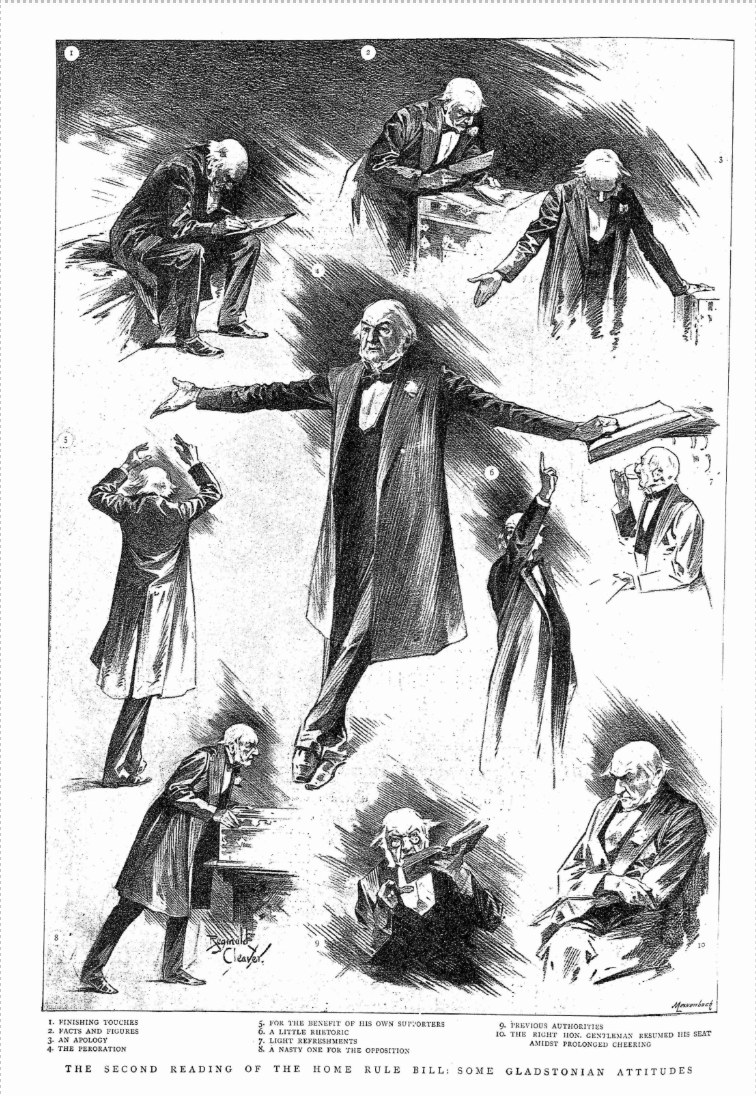
William Gladstone's gestural repertoire during the second reading of the Home Rule bill, pictured in The Graphic, 22 April 1893, p. 428.
Even so, the cultural zenith of emotive rhetorical gesture was perhaps located in the second quarter of the twentieth century, with the advent of fascism and national socialism. Although clearly rooted in the classical tradition, the oratorical styles of Benito Mussolini and Adolf Hitler were far more physically and emotionally expressive than the liberal democratic oratory of the previous century. Moreover, with the adoption of the pseudo classical ‘Roman salute’, they not only found a hand gesture that conveyed their political message, they established a habitualised social gesture that served to embed the party and its values in the national psyche through repeated, daily, emotional mobilisation.
Meanwhile, the fascist salute had its socialist counterpart in the raised clenched fist. This hand gesture was rooted in the cultures of organised labour and resistance that developed across the nineteenth century, wherein the fraternal workers’ hands morphed into the defiant and militant fist of the socialist proletariat. However, it really came to prominence in the 1930s as the official salute of the German Communist Party’s (KPD) paramilitary ‘Red Front’ (RFB). Moving from Weimar Germany though the Spanish Civil War to the Black Power movement of post-war America, this raised clenched fist became the primary embodied gesture for a variety of different activist and radical social and political movements in the later twentieth- and twenty-first centuries, galvanising feelings of defiance, resistance, and empowerment.
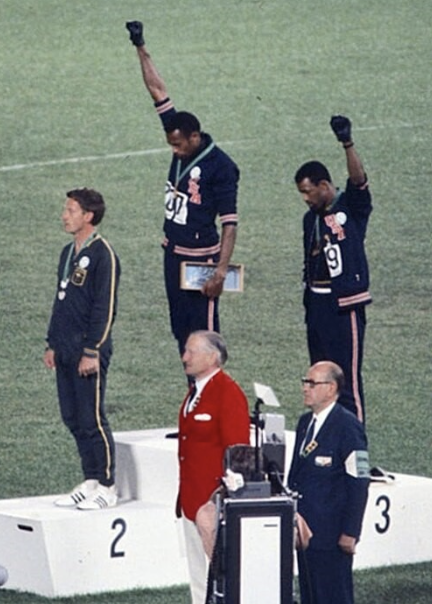
African American athletes Tommie Smith and John Carlos make the Black Power Salute at the Mexico Olympics, 16 October 1968.
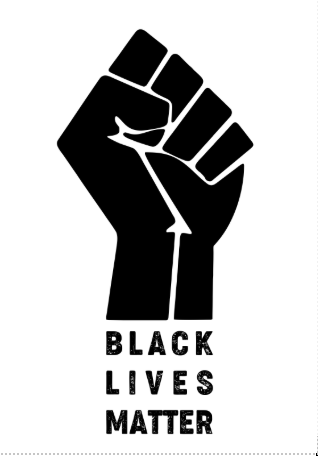
Black Lives Matter logo.
Moreover, through its reproduction in media, the gesture has become an emotional prosthetic whose impact extends beyond the immediacy of the act to those who encounter it in its material forms. This is most powerfully revealed in its use in the Black Lives Matter movement from 2013 onwards, and especially after the murder of George Floyd in 2020. An analysis of 1.13m public Instagram posts during the ensuing global protests reveals that the third most common visual images posted was the BLM’s official logos, which include the clenched fist. Indeed, this was among the ‘top 9 most diffused icons’.
In the last decade or so, embodied gestures including those once thought consigned to political history have made a comeback, notably in the United States, where far-right ideology has become increasingly prominent under the presidential tenure of Donald Trump. Since 2016, several hand signals have worked their way into American political culture and drawn media scrutiny. At first relatively obscure, such as the ‘OK’ gesture linked to alt-right elements on the internet message board 4Chan, they culminated in Elon Musk’s seemingly open fascist salute at Trump’s second inauguration in January 2025. Although such far-right gestures have become ever more explicit, they remain clouded in layers of memeification and ironisation, wherein their power lies in an inherent clarity of meaning matched to a conscious deniability of intent.
Indeed, the fluidity of sign and signifier that characterizes the iconography of the American right in power is nowhere more clearly expressed than in the confused gestural repertoire of Donald Trump himself. Alongside the customary ‘sand pinch’ when speaking, or his double-handed thumbs up pose for the cameras, Trump has regularly employed the raised clenched fist, perhaps most iconically during the failed assassination attempt of July 2024. Quite what this gesture means to Trump is hard to say. Perhaps it is an unreflective expression of defiance; perhaps it is a deliberate appropriation of the gestural iconography of his opponents. Trump does not convey the sense that he is a deep thinker or ‘edgelord’ ironist, so it could simply be indicative of his status as a semiotic ‘Teflon Don’, to whom any attempt to ascribe coherent symbolic meaning is doomed to fail.
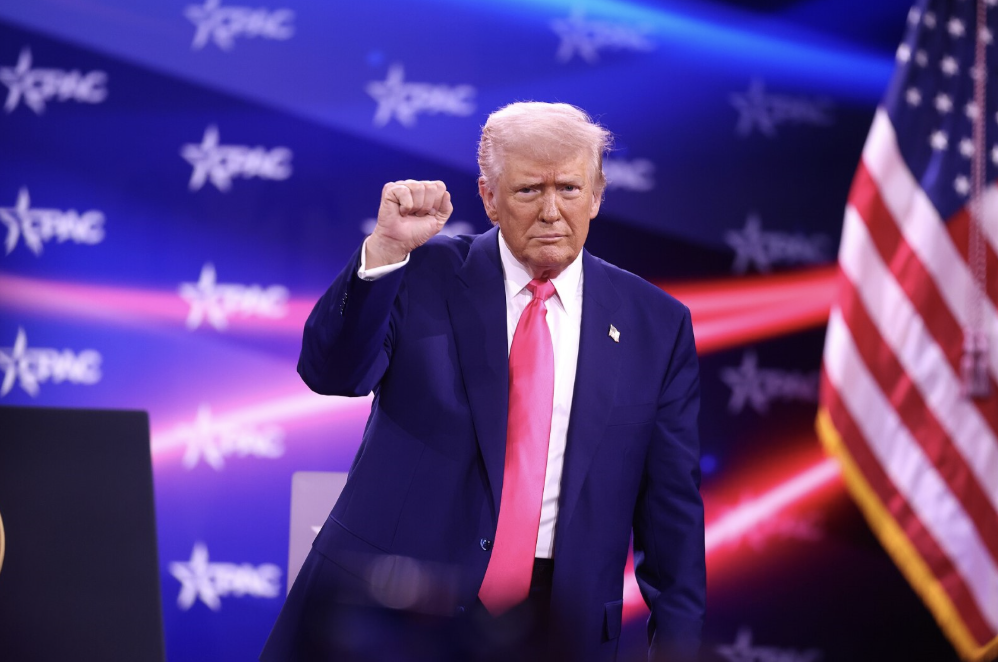
Donald Trump makes the clenched fist gesture at the Conservative Political Action Conference in 2025.
As we hope to show in this blogpost, the history of hand gestures, and the emotions they elicit, is no marginal pursuit, but instead an activist form of history whose goal is to deny bad faith actors their semiotic sleight of hand and to advance understanding that while bodily gestures can be consciously understood to incite hatred, they can also be deployed to empower positive change.
Recommended reading:
Gary Osmond, ‘Photographs, Materiality and Sport History: Peter Norman and the 1968 Mexico City Black Power Salute’, Journal of Sport History 37, no. 1 (2010): 119-37
Gottfried Korff, ‘From Brotherly Handshake to Militant Clenched Fist: On Political Metaphors for the Worker’s Hand’, International Labor & Working-Class History 42 (1992): 70-81
Ho-Chun Herbert Chang, Alissa Richardson, and Emilio Ferrara, ‘#JusticeforGeorgeFloyd: How Instagram facilitated the 2020 Black Lives Matter protests’, PLoS ONE 17, no. 12 (2022): 1-19
Jason Peacey, ‘Disorderly Debates: Noise and Gesture in the 17th-Century House of Commons’, Parliamentary History 32, no. 1 (2013): 60-78
John Walter, ‘Shaking Hands and the Politics of Touch in Early Modern England’, Past and Present 267 (2025): 48-79
Mary Fulbrook, ‘Embodying the Self: Gestures and Dictatorship in Twentieth-Century Germany’, Past and Present supplement 4 (2009): 257-79